Who arrives, who stays and who leaves.
These lists rest on the first and last time each species was heard. A species silent for a week has probably headed south again, though without certainty (a silent microphone does not prove a bird is absent).
Newcomers
First heard less than 10 days ago.
Still here
Heard in the last three days, arrived earlier.
Probably gone
Silent for 7 to 45 days.
The season, species by species.
Each row is a species (in the order it was first heard) and each cell a week or a day. The darker the cell, the more episodes there were. The waves read from top to bottom, from the August breeders to the shorebirds passing through in September and on to the birds that herald winter.
The waves, group by group.
The first chart stacks each week’s episodes by species group. The second, the accumulation curve, gives the number of different species recognized since the station was installed.
Episodes per week
A week without complete listening (breakdown, outage) looks quieter than it really was.
Species accumulation curve
Each step is a new species. The slope flattens as the season goes on, then steepens again with the arrival of the winter birds.
When does the tundra sing?
Each column is a day and each row an hour. The two lines follow sunrise and sunset as calculated for the camp. You can watch the dawn chorus shift as the days grow shorter.
Wind, cold and birds.
These charts give the average number of episodes per daylight hour, according to the wind and temperature measured in the same hour. They should be read with caution. A strong wind drowns out songs and leaves the microphone a little hard of hearing. The cold, for its part, arrives at the same time as the end of the season. What they show is what the station hears, which is not quite the same thing as what the birds are doing.
Sounds and their spectrograms.
For each species and each day, the station publishes the six-second clip it is most confident about. The spectrogram shows frequencies (from 0 to 12 kHz, on the vertical axis) over time. Clicking the image starts playback and a cursor follows the sound. A filter automatically discards any segment in which a human voice is recognized.
All the species heard.
Click a column heading to sort the table. The small histogram summarizes the model’s confidence for each episode, from 70% on the left to 100% on the right. The “to be validated” flag marks a species heard rarely and with modest confidence, which is best listened to again before drawing any conclusion.
Birds in Innu-aimun
13 words · Innu-aimunNaming a bird in the language of the land ties it to the world it was born into. These words are taken from J. Bishop’s thesis and written in modern spelling. Innu-aimun has dialect variants and the speech of the Mushuau Innu has its own forms (a word may sometimes differ from one community to the next).
The Ungava grizzly, a ghostly presence.
For more than a century, Innu and Inuit hunters, Hudson’s Bay Company clerks and explorers spoke of a great brown bear of the barren lands, larger and more feared than the black bear. With no specimen in hand, its existence was long doubted. Then, in the mid-1970s, the archaeologist Steven Cox unearthed a grizzly bear skull (Ursus arctos) in the midden of an eighteenth-century Inuit sod house on Okak Island, Labrador. For Stephen Loring and Arthur Spiess, this discovery “effectively ended speculation about the former existence of the species in the barrenlands of northern Quebec and Labrador”.
Their 2007 article adds two new pieces to the file. The first is a photograph taken in August 1910 by William Brooks Cabot at Kaiaukuapiskasts, which Cabot called Long Pond, on the Innu trail linking the camp of Tshinutivish, on Mushuau-nipi, to Voisey’s Bay. A bear skull is tied to the top of a pole, as the Innu did out of respect for the animal. The authors compared its profile with those of six grizzlies and about fifteen black bears in the Smithsonian collections. The dished forehead of the skull resembles that of the Northwest Territories grizzlies and of the Okak skull more than that of any of the eastern Canadian black bears they examined. They remain cautious: “we acknowledge that this attribution cannot be conclusive”.
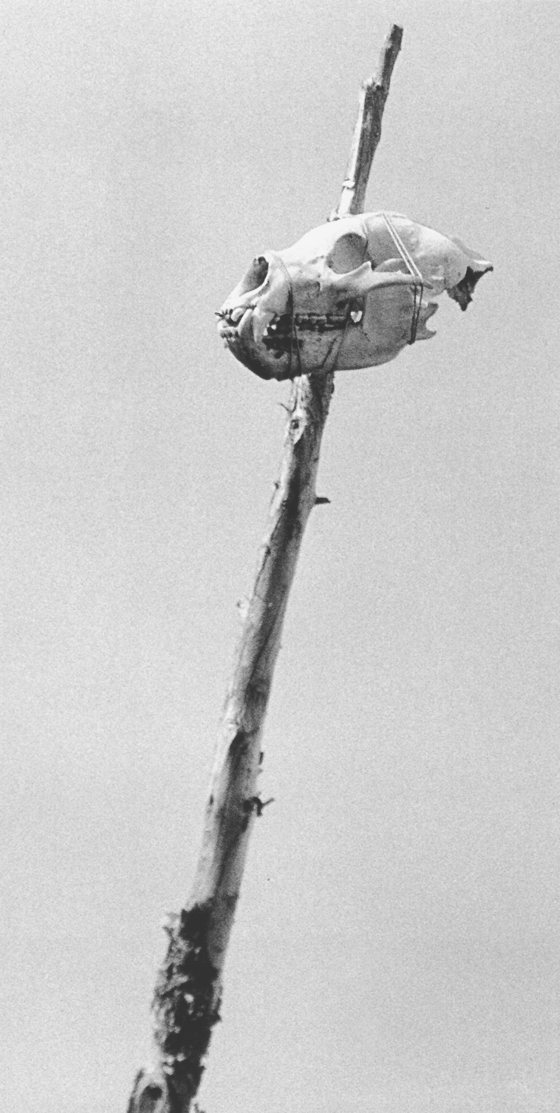
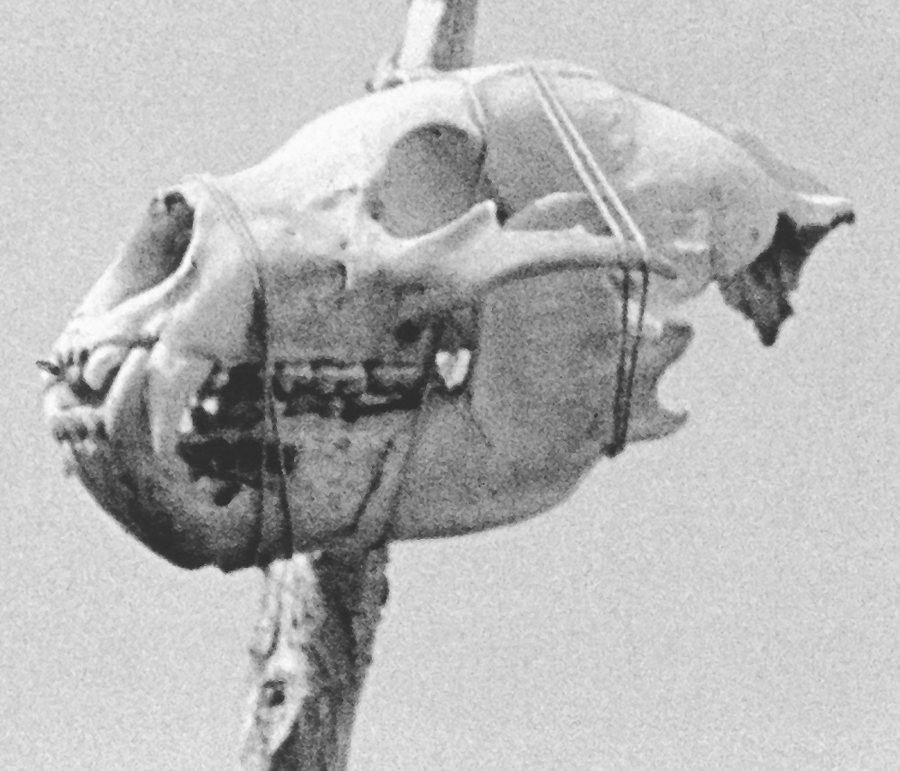
The second is an unpublished manuscript by Lucien Turner, a Smithsonian naturalist stationed at Fort Chimo from 1882 to 1884. Turner describes a barren-ground bear that haunts the George River valley itself.
“A species of Bear supposed to be the Barren Ground Bear is well known to inhabit the sparsely timbered tracts along George’s River from within thirty miles of its mouth to the headwaters. This animal is not plentiful, although common enough and too common to suit some of the natives who have a wholesome dread of it.”
Turner never managed to obtain a specimen, despite the large reward on offer, but he saw two skins. The Innu called it matashu. Around 1870, a hunter from Pettisikapau Lake is said to have killed three after they attacked a woman. Around 1911, an Innu man from Sept-Îles is said to have seen one but did not dare shoot. In 2004, Francis Benuen still recalled that his father, before 1930, had killed two cubs whose mother he never saw. Jacques Rousseau, crossing the peninsula in 1948, already spoke of it in the past tense: “Long ago, it seems, skins of a tundra grizzly bear were brought to the Hudson’s Bay Company posts […]. They have even deserted the memory of the Indians” (our translation).
Loring and Spiess place the probable core of this small population around Kameshtashtan (Lake Mistastin), east of Mushuau-nipi, and believe it survived into the twentieth century. Their conclusion has a melancholy ring: “Soon no memory of grizzly bears will remain among the people of the Ungava region.” The camp microphone will never hear this great brown bear, and what we know of it now rests on the archives and on the stories that remain.
Sources: Stephen Loring and Arthur Spiess, “Further Documentation Supporting the Former Existence of Grizzly Bears (Ursus arctos) in Northern Quebec-Labrador”, Arctic, vol. 60, no. 1, 2007, pp. 7–16; Jacques Rousseau, À travers l’Ungava, 1949, p. 126.
Method and data
The microphone (a Clippy EM272 capsule) records continuously. The BirdNET model (version 2.4) analyzes the sound on site, on the station’s Raspberry Pi, with the following settings.
- Confidence threshold of 0.75 (0.70 until 16 October 2026). Below it, nothing is kept.
- Sensitivity of 1.25 and a species occurrence filter based on the week and the location (56.40° N, 64.76° W).
- Three-second windows overlapping by 1.5 seconds (2 seconds until 16 October 2026). Every moment is therefore analyzed more than once, hence the notion of an episode, in which detections of the same species less than 2 minutes apart form a single episode. Unlike raw detections, episodes remain comparable from one period to another.
- Privacy filter. Any segment in which a human voice appears among the model’s top ten hypotheses is discarded, along with its neighbours.
An automatic model is sometimes wrong, especially with rare species or those outside their range. Those flagged “to be validated” deserve a second listen. Bird names in English follow BirdNET and the American Ornithological Society. The data belong to the Corporation du Mushuau-nipi.
Open data, CSV format (column headings and species names in French): raw detections · episodes · weather data.